









The Cathay Group has long regarded low-carbon operations as an important operational development goal. Cathay Century Insurance has led the industry in recent years and achieved important milestones in carbon management. In 2020 and 2021, we obtained a product carbon footprint label and a carbon reduction label. In 2025, we will continue to strengthen our low-carbon transformation strategy, initiate product carbon footprint verification extension procedures, and comprehensively review our product life cycles from raw material acquisition and service solicitation to final waste disposal. We plan to identify key carbon emission hotspots through systematic inventory procedures to serve as an important basis for low-carbon operations and decision-making. We hope to become a benchmark for carbon management by continuing to act as a green pioneer in the property insurance industry, not only building comprehensive carbon management measures for ourselves, but also driving carbon-related opportunities and developments to promote sustainable transformation within industries and across Taiwan.
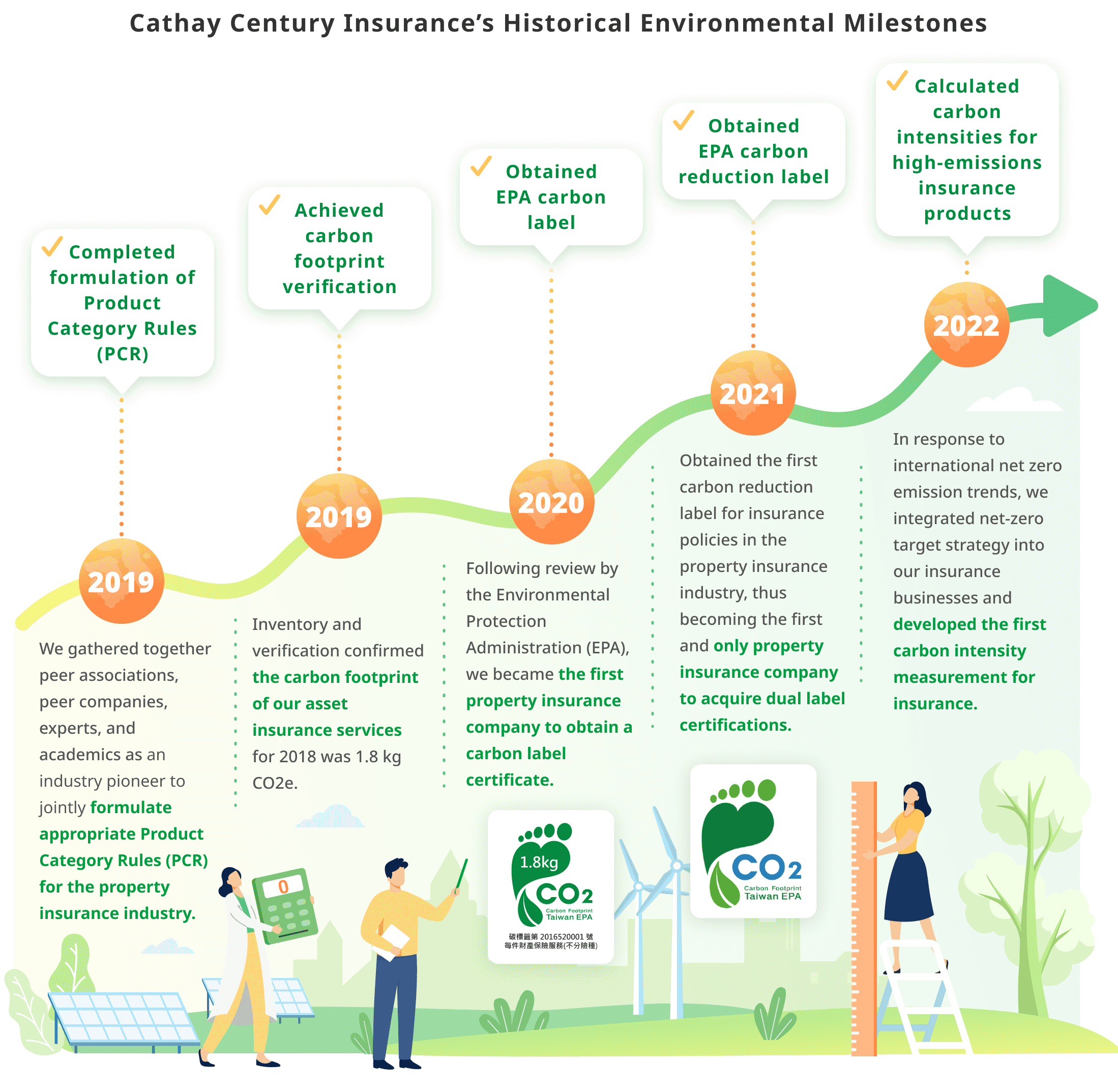

Cathay Century Insurance used the “Environment and Energy Management Policy” formulated by Cathay Financial Holdings Group to manage environmental impacts from operations and upstream suppliers. We adhere to SBTi, RE100, and other international sustainability initiatives, and pledged to reduce carbon emissions by 42% before 2030 and raise renewable energy usage at all operational sites to 100% by 2030. We formulated strategies and conducted implementations based on our net zero emissions targets.
We obtained the first carbon footprint label in the property insurance industry issued by the Environmental Protection Administration (EPA) in 2020 and subsequently obtained the carbon footprint reduction label certification in 2021, becoming the first and only insurance company in Taiwan to obtain the dual certifications. Through carbon footprint verification (CFV) of the entire service process, we can better identify the hotspots for carbon emissions throughout the insurance policy’s life cycle, so as to prioritize resource investments and to set cost-effective reduction targets as well as green products and sustainable procurement as the basis.
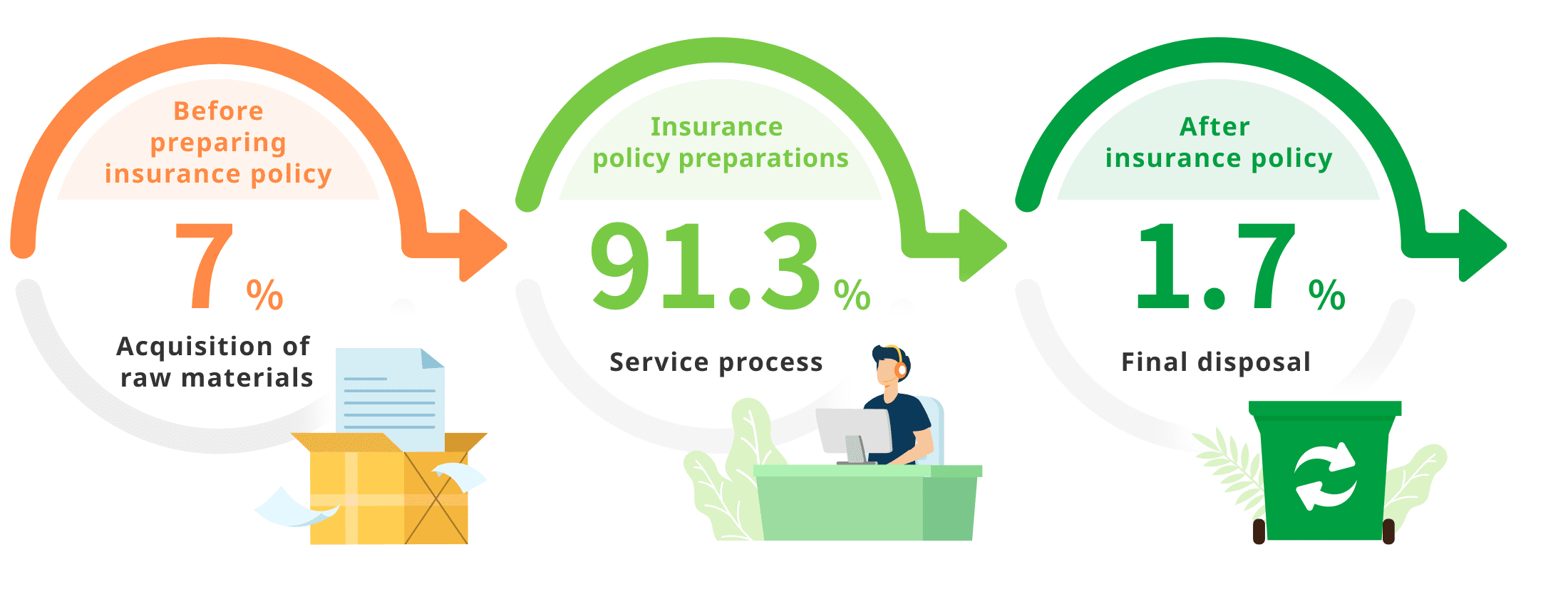
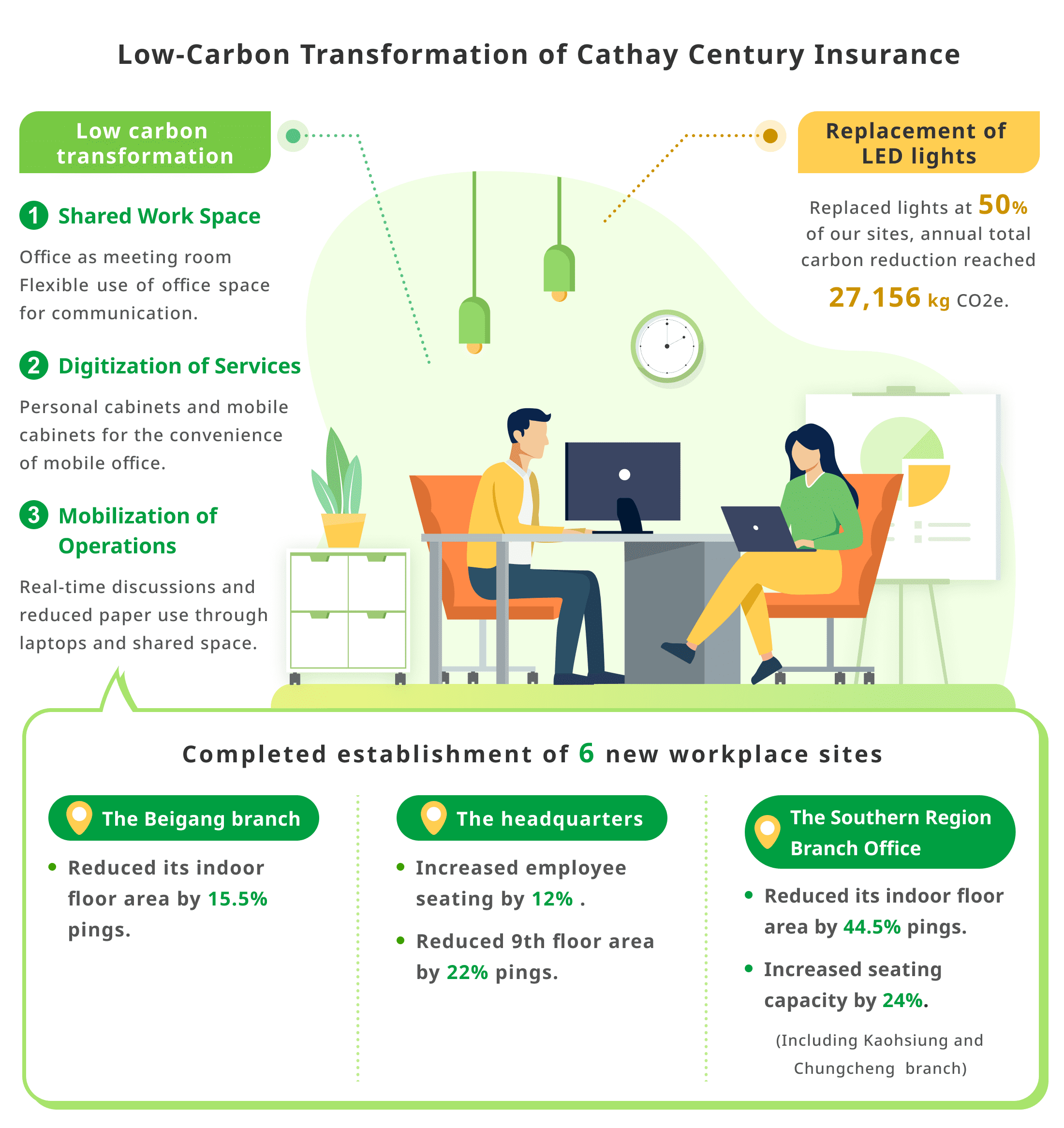
Cathay Century Insurance adopted greenhouse gas inventory procedures in 2013 and continues to review carbon emission sources. We introduced digital and electronic processes into internal administrative operations to enhance operational efficiency and reduce paper usage. We used apps, tablets, laptops, and other tools to mobilize traditional office tasks, freeing them from location and time constraints. We also replaced old lighting equipment in workplace environments with energy-saving LED lights and changed desktops to laptops to increase workplace energy savings.
We use various digitalization measures to familiarize colleagues with digital tools and formulated “Workplace Transformation” action plans to reduce office areas and idle space, thereby enhancing workplace utilization efficiency while lowering electricity consumption from air-conditioners and lights as we move toward our net zero transformation targets.

Cathay Century Insurance actively supports internal energy and carbon reduction policies, and has long implemented waste management across corporate operations. According to statistics, all waste generated by Cathay Century Insurance is general waste, which is processed by outsourced professional vendors. In terms of waste reduction management, we implement source management through various measures, while expanding inventory sites and introducing classification systems to enhance overall resource recycling benefits. The Company also continues to collaborate with external organizations to promote recycling and resource reuse. Through the “Recycled Computer Project” in collaboration with ASUS Foundation, we recycled and donated 1,460 desktops and 689 monitors.CS Report

